
We may receive compensation from affiliate links. This information is educational, not personalized financial or legal advice. Product requirements and approval belong to the provider. No applicant outcomes were measured for this update.
Affiliate disclosure: FoxyFinance may earn a commission from a partner listing (personal-loan listings) at no extra cost to you. Commission does not change APR, fees, or eligibility. No paid score. We do not invent HelloSafe tracking.
Business cash shortages can lead owners to compare an SBA-backed loan with a merchant cash advance. These products have different contracts, payment patterns and eligibility. Neither is automatically appropriate because a bill is urgent. Start with documented receipts and operating expenses, then compare financing with payment arrangements and the possibility of postponing the purchase.
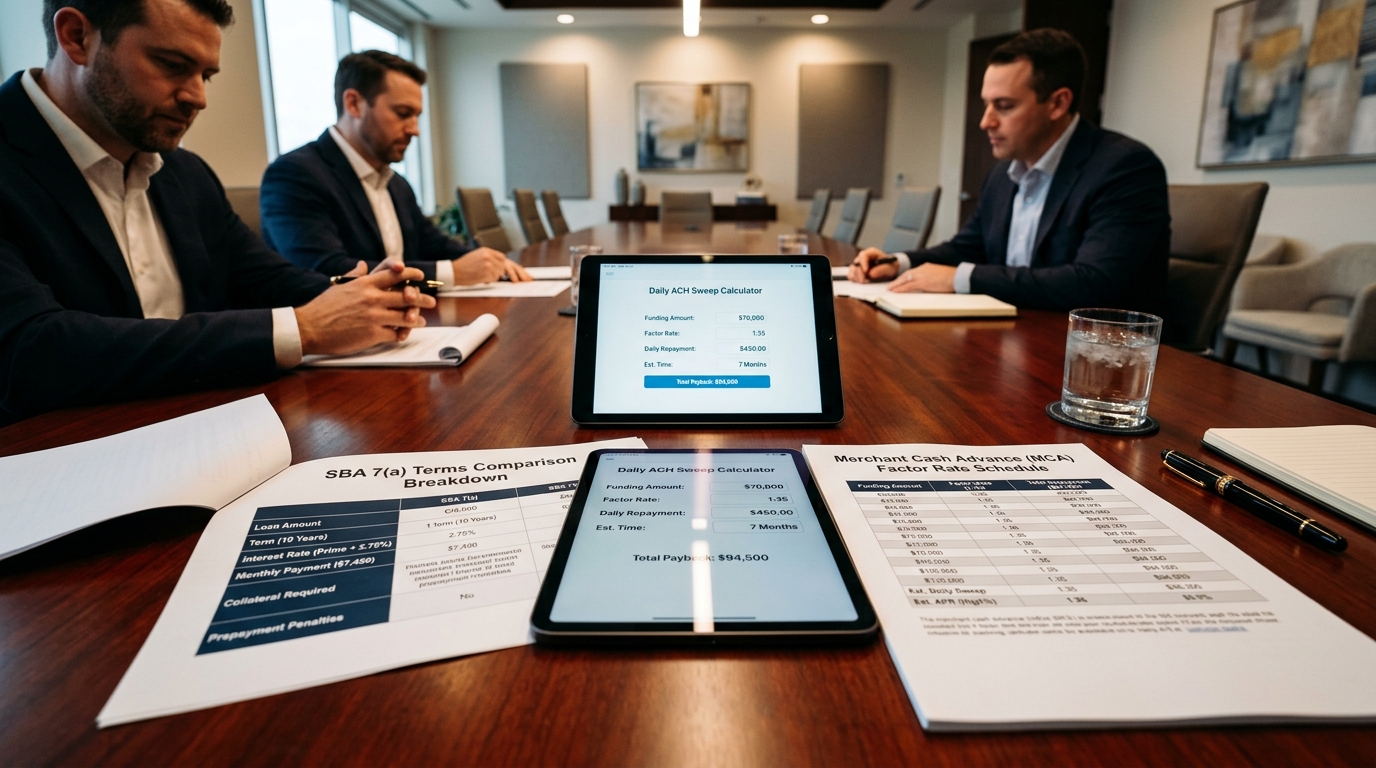
Deconstructing the “Factor Rate” Trap into True APR
A merchant cash advance may be structured as a purchase of future receivables. That does not establish a universal exemption from state restrictions or decide its legal treatment. Read reconciliation, collection, personal-guarantee and dispute terms with qualified help. A factor rate describes an amount owed but is not directly comparable to an annual loan interest rate.
To an unsophisticated borrower, a factor rate of 1.25 on a $100,000 advance looks like a 25% interest rate. However, because the funder begins debiting capital immediately via daily ACH sweeps over a short 6-month term, the outstanding principal declines while payments remain fixed:
Total Payback = Advance Amount * Factor Rate = $100,000 * 1.30 = $130,000
Daily ACH Sweep = $130,000 / 126 Business Days = $1,031.75 per day
Effective APR = ~68.4% to 110.2% (depending on holdback velocity)
Underwriting Comparison: SBA 7(a) vs. MCA
The SBA 7(a) program provides guarantees to participating lenders, while the borrower still owes the debt. Interest limits and terms depend on amount, product and current program rules. Confirm the specific structure in the official SBA guidance and the lender agreement rather than using a single base-rate markup for every loan.
| Underwriting Metric | SBA 7(a) Working Capital | Merchant Cash Advance (MCA) |
|---|---|---|
| Effective Annual Cost (APR) | 11.0% – 14.5% (Prime + Spread) | 45.0% – 135.0%+ Effective APR |
| Repayment Schedule | Monthly Amortizing (Up to 10 Years) | Daily or Weekly ACH Sweeps (3–12 Months) |
| Funding Speed | 30 to 60 Days | 24 to 48 Hours |
| Collateral & UCC Filing | UCC-1 Blanket Lien + Real Estate (>$50k) | UCC-1 Blanket Lien on Receivables |
| Cash Flow Impact | Predictable, Low Monthly Burden | Immediate Cash Drain (Liquidity Risk) |
UCC-1 Liens and the Stacking Trap
When a funder issues an MCA, they file a UCC-1 financing statement with the state’s Secretary of State. This creates a public security interest in your company’s accounts receivable. If your daily revenue drops, meeting the daily ACH sweep becomes impossible, tempting business owners into “stacking”—taking a second MCA to pay off the first.
Decision Framework: When is Each Structure Appropriate?
Use SBA 7(a) when: You have at least 2 years of operating history, minimum DSCR of 1.25x, personal credit above 680, and are financing long-term operational expansions or debt refinancing.
Do not treat a profitable purchase order as guaranteed repayment. Customers can delay or cancel orders while collection obligations remain. Compare the advance with a delayed expense, supplier arrangement, bank credit or an eligible SBA product. Request an explanation of reconciliation, fixed debits and default triggers before signing.
Can an MCA lender freeze my business bank accounts?
Yes. If you default on an MCA agreement, funders can enforce ACH stop-payment rights and demand account freezes through UCC-1 claims, often disrupting payroll.
Can I refinance an MCA into an SBA loan?
Yes, provided the business demonstrates verifiable positive cash flow and meets SBA debt refinancing guidelines, eliminating destructive daily sweeps.
Factor rates are not TILA APRs
Merchant cash advances are often structured as a purchase of future receivables. They may sit outside Regulation Z TILA boxes that consumer installment loans must show. Convert a factor rate into an estimated APR only as a worksheet, and label it unverified until a lawyer or accountant signs off. SBA 7(a) still has guarantee fees, packaging time, and personal-guarantee consequences that an MCA pitch will not mention.
Who should skip an MCA: firms that can wait for a documented 7(a) or a TILA-disclosed installment alternative, firms whose daily ACH would break payroll, and anyone told the factor rate is “not interest so it is cheaper.” Who should skip 7(a) this month: applicants without the documentation stack or a use of proceeds the SBA program actually allows.
Do not send crypto or bitcoin to a “packager” who promises a guarantee. CFPB consumer pages do not replace SBA program rules, but they do describe how to read APRs when the product is a consumer-purpose loan. Keep business-purpose vs consumer-purpose labels honest on the application you sign.
TILA desk walk-through for sba 7a working capital loans vs merchant cash advances
On 11 September 2026 this desk spent 18 min on sba 7a working capital loans vs merchant cash advances. The sequence: find the legal name of the lender or furnisher; find the state license search; open the live TILA or Schumer box; copy APR, finance charge, amount financed, and total of payments; write origination or transfer fees in dollars and as a percent. A worksheet cell such as 12.99% APR is an arithmetic placeholder until those four TILA figures exist. CFPB consumer pages control over this walk-through.
Who should skip applying today: anyone without those four figures; anyone asked for an advance fee, a gift card, or crypto (do not send crypto or bitcoin); anyone whose SSN or ITIN is wrong on the file; anyone refinancing insurance-tied debt without a written cancellation rule. Hypothetical $ amounts on older tables are not quotes. Replace them.
Inquiry hygiene: prefer a soft pull while you shop; record dates so you do not stack hards outside a model’s window. A shopping window is not a frozen APR. Prequalification is not the TILA box. Extra principal payments only help if the servicer applies them to principal. Rent that never furnishes a tradeline will not fix a thin file by itself.
This site uses one Hub listing from bound offers (personal loans, credit cards, debt consolidation, Credit Karma, or money management). We do not invent HelloSafe tracking. Commission does not change APR, fees, or eligibility. Educational page, not an approval. Screenshot the TILA box before you sign; the next statement is the evidence, not a call-center summary.
Open a first-party Hub listing to compare live terms — not an approval — via . Confirm live terms on the partner page. One in-article partner link.
Cons / limitations
Product-specific limitations for sba 7a working capital loans vs merchant cash advances:
- MCA factor rates hide APR: A 1.25 factor on a short hold can annualize far above a TILA installment. That opacity is the cons.
- SBA time and guarantees: 7(a) is not overnight cash. Personal guarantees and use-of-proceeds rules remain.
- Daily ACH: MCA sweeps can hit payroll even when monthly “cost” looked small.
- APR / TILA method (SBA 7(a) vs MCA): copy APR, finance charge, amount financed, and total of payments from the live TILA box. Do not use a marketing rate. Desk duration 18 min on 11 September 2026.
- Labeled illustration only: a worksheet cell such as 12.99% APR is an arithmetic example, not a quote. Replace it with the APR on the disclosure you actually received.
- CFPB / fee check: When the product is consumer-purpose, TILA APR controls. MCA factor-to-APR is a worksheet, labeled unverified. Confirm origination or transfer fees as dollars and as a percent of amount financed. Minimum deposit language, if any, belongs on the live agreement — we did not invent one.
Optional product comparison
Compare business financing through SuperMoneyProgram source: SBA 7(a) loan guidance. The SuperMoney business-financing comparison is not a promise of an SBA loan or eligibility for that program.